
Winter radish: a firm root after the summer harvest
Winter radish offers a different harvest time from a quick-growing radish. The root gets more time and space and can be used raw or in cooked dishes. Choose a summer or winter type deliberately, rather than sowing everything according to the ordinary radish calendar.
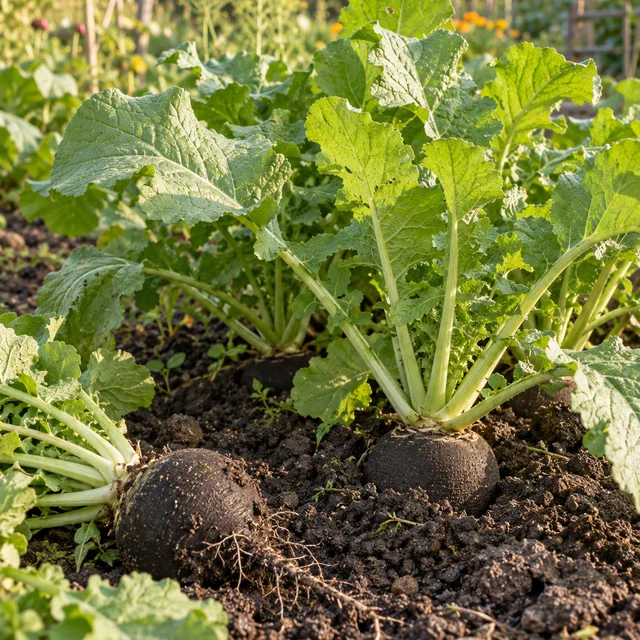
This image was created with AI from described plant characteristics and growing advice. It shows a possible situation and is not a photograph of a verified cultivar.
- Sowing
- Summer for winter types; follow the cultivar
- Harvesting
- Autumn and early winter
- Location
- Light, well-structured soil
- Space
- Larger roots need more spacing than salad radishes
This growing advice helps you choose. Your variety, growth stage, weather and conditions in your space determine the actual timing.
Sowing under cover and raising seedlings
Sow directly for young leaves or roots · Winter radish
July–August, depending on cultivarSow directly into deep soil; thin in time.
- Germination and temperature
- Wait for workable, warmed soil; follow the cultivar’s minimum sowing temperature.
- After emergence
- Keep the seed row evenly moist during emergence and identifiable with a label.
- Pricking out and potting on
- Sow thinly and thin in the final position where needed. For cutting leaves, every seedling need not stand separately.
- Hardening off and planting out
- Stays where sown; hardening off and planting out are unnecessary for direct sowing.
Many winter radishes suit summer sowing. Use a cultivar suited to the chosen day length and sowing period.
Sources and use
Royal Horticultural Society · RHS — radijs kweken ↗Soort- of productgebonden bron; buitenlandse perioden zijn geen vaste Nederlandse zaaidatum.
De Bolster · De Bolster — rammenas telen ↗Nederlandse producent of teeltbron; de rasinstructie blijft leidend.
Guideline periods for the Netherlands and Flanders. Check the variety, available light, soil and measured temperatures. Greenhouse heating does not guarantee enough winter light.
A different flavour, a different harvest.
Choose by more than the name. Discover how these varieties and crop types taste, what you can use them for and what growing them involves.
1 of 1 choices · 0 named varieties
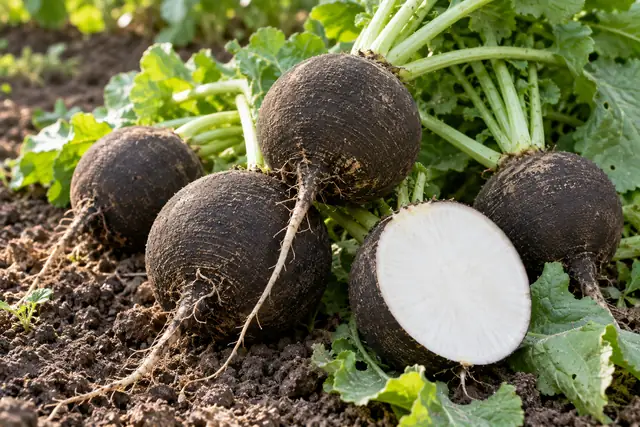
This image was created with AI from described plant characteristics and growing advice. It shows a possible situation and is not a photograph of a verified cultivar.
Ronde zwarte
A black round winter radish with a white interior.
Choose Ronde zwarte as a winter radish type for a late harvest and storage. It is a general type designation, without an extra assumed cultivar in the list.
Flavour, kitchen and growing
How does it taste?
The white interior is crisp and peppery. The black outer skin mainly provides appearance and recognition; use a small raw tasting to assess the heat.
This flavour description applies to the crop; there is no separate tasting result for this variety.In the kitchen
Finely grate winter radish for a quark sandwich topping or mix it with apple in a raw salad. Cooking in soup makes gentler use of a larger root.
A space in the garden
Sow in summer according to the packaging; early spring sowing is less suited to this late purpose. Thin with enough space for round storage roots.
Harvesting
Lift in autumn before severe frost damages the swollen roots. Store undamaged roots cool, protected from drying out, and use soft or damaged specimens first.
Read the source notes →Choose your way to grow
From a garden bed to a suitable pot or support: give your plant a place that suits your garden and the care you can provide.
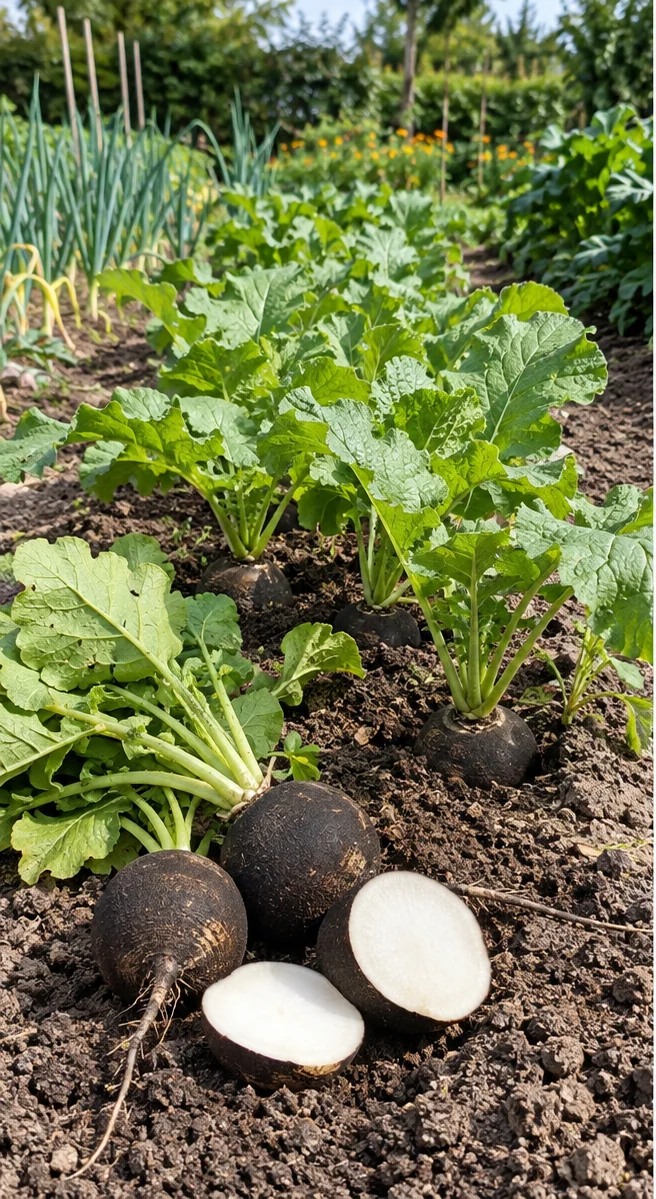
This image was created with AI from described plant characteristics and growing advice. It shows a possible situation and is not a photograph of a verified cultivar.
Sowing directly into a cleared bed
A root builds its harvest underground. First choose workable soil and a spot that will stay available for long enough. Sow directly and keep the row identifiable, even while seedlings are still small.
- Remove stones, weeds and hard clods without smearing wet clay into a compacted surface.
- Sow at the depth for the cultivar and keep the germination zone moist.
- Thin in time and harvest a first test specimen.
For anyone with a suitable bed and enough root space.
Tick off your supplies →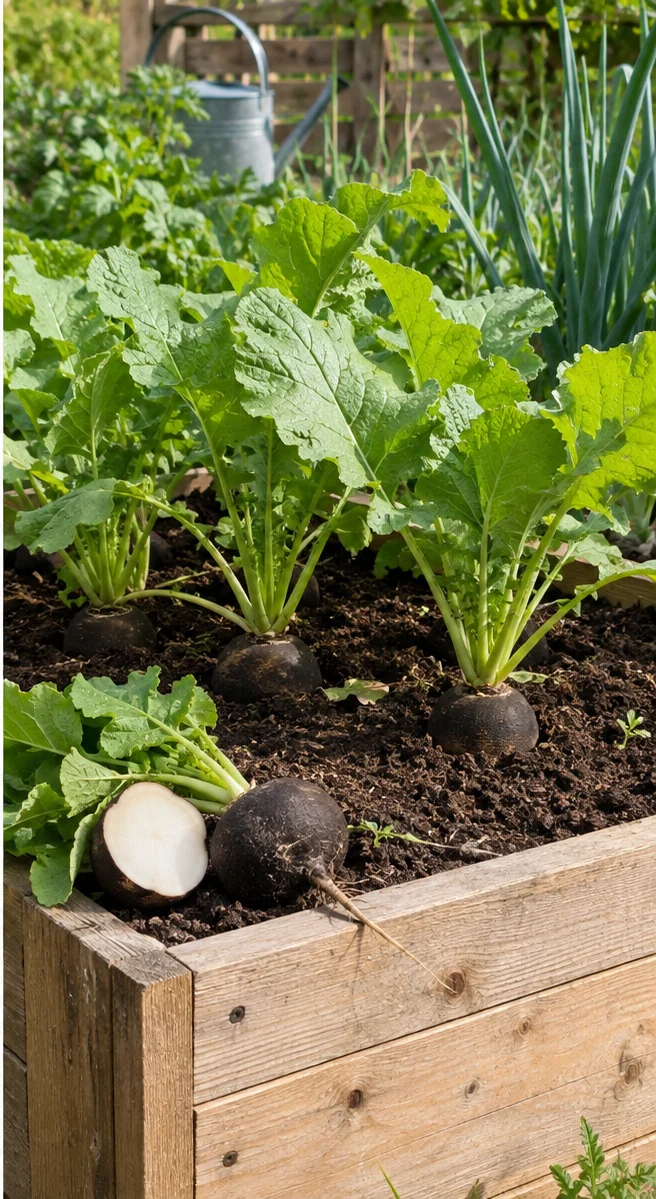
This image was created with AI from described plant characteristics and growing advice. It shows a possible situation and is not a photograph of a verified cultivar.
A small trial in a suitable container
A broad, deep container can support a small trial crop. Match depth to root shape: long types need more soil beneath them than round types. Sow directly, thin and check moisture regularly.
- Check the cultivar’s expected root size.
- Choose a container with enough depth and unobstructed drainage.
- Sow directly and check moisture more often than in the ground.
For limited space, provided the container suits the root shape.
Tick off your supplies →Choose by flavour, shape and use
Ronde zwarte: Black, round winter radish with a white interior. Finely grate winter radish for a quark sandwich topping or mix it with apple in a raw salad. Cooking in soup makes gentler use of a larger root.
The white interior is crisp and peppery. The black outer skin mainly provides appearance and recognition; use a small raw tasting to assess the heat.
Choosing a suitable root crop
Winter radish and rettich describe different large radish types. Round black winter radish differs in form from long white rettich. Use your variety's sowing, spacing and storage data without copying properties between forms.
Make room underground
Feel whether the soil is loose enough below the top layer. A fine surface can hide a hard layer. Carefully relieve obstructive compaction when the soil is workable. Avoid fresh, coarse manure directly in a row where straight roots need to develop.
Sow in the final position
Sow winter radish in summer in its final position. Sowing too early can trigger flowering when you want a swollen root. Check the variety window and keep the germination zone evenly moist during summer drought.
The surface layer deserves attention
After sowing, keep the germination zone evenly moist. A hard crust and drying can hold back small plants. Water with a fine rose and do not walk over the row. A label helps you find the sowing position before recognisable leaves appear.
Give every young plant its own space
Thin young plants to the variety's wider spacing. Large roots need large leaves too. Keep weeds from filling the row, taking both space and water as roots need to fill.
Growing without large fluctuations
During dry periods, check moisture below the surface. Young plants and containers need more frequent watering checks than a well-rooted crop in a bed. Water according to need and let it soak down; a wet surface every day tells you little about the root zone.
Take time over the first one
Harvest once the root reaches a useful cultivar size, usually in autumn for winter types. Loosen the soil carefully. Lift a supply before severe winter weather if the growing position becomes too wet or cold for safe harvesting.
An unusual root tells you something
Bolting, small roots or growth cracks call for assessing timing, spacing and moisture. Root tunnels may indicate cabbage root fly. Remove clearly affected plants and follow cabbage rotation; a new seed packet does not remove a soil problem.
Start with a sound harvest
Use damaged roots first and store only sound ones, following guidance for the type and cultivar. Cool conditions and suitable humidity help limit drying, but check for deterioration. Storage advice for one winter cultivar is not a shelf-life promise for the whole species.
What you need
Tick what you already have. The extras depend on how you grow.
0 of 5 ticked off
Your ticks are saved in this browser.
Discover and grow more
More background, sources and image information
SeedSteps editorial team · updated on 11 October 2026. The AI images illustrate species and practical growing situations; they do not prove an exact cultivar, observations from your own garden or yield.
Britse gewasadviezen worden gecombineerd met Nederlandse en Vlaamse informatie waar beschikbaar. Amerikaanse Extension-bronnen ondersteunen plantprincipes en herkenning; hun kalenderdata, lokale plaagdruk, bestrijdingsmiddelen en mestdoseringen worden niet rechtstreeks op Nederland of Vlaanderen toegepast. Vorst, bodemwarmte, standplaats en expliciete rasinformatie blijven de lokale controle. Commerciële bronnen onderbouwen uitsluitend benoemde ras- en plantkenmerken; zij zijn geen affiliate-aanbeveling.
- World Checklist of Vascular Plants — 4 juni 2026Royal Botanic Gardens, Kew · accessed 2026-10-07
- Organic Rammenas Ronde Zwarte zadenFeggies · accessed 2026-10-11
- Radis d’hiver: teelt en gebruikSemailles · accessed 2026-10-11
- De Bolster — rammenas telenDe Bolster · accessed 2026-10-10
- RHS — radijs kwekenRoyal Horticultural Society · accessed 2026-10-10
- USU Extension — radijs in de tuinUtah State University Extension · accessed 2026-10-10
Supporting evidence by chapter: Choose by flavour, shape and use: Feggies, Semailles. Choosing a suitable root crop: Royal Horticultural Society, De Bolster, Utah State University Extension. Make room underground: Royal Horticultural Society, De Bolster, Utah State University Extension. Sow in the final position: Royal Horticultural Society, De Bolster, Utah State University Extension. The surface layer deserves attention: Royal Horticultural Society, De Bolster, Utah State University Extension. Give every young plant its own space: Royal Horticultural Society, De Bolster, Utah State University Extension. Growing without large fluctuations: Royal Horticultural Society, De Bolster, Utah State University Extension. Take time over the first one: Royal Horticultural Society, De Bolster, Utah State University Extension. An unusual root tells you something: Royal Horticultural Society, De Bolster, Utah State University Extension. Start with a sound harvest: Royal Horticultural Society, De Bolster, Utah State University Extension.