
Yellow Crookneck: discover the flavour and growing
Heldergele vruchten met een gebogen hals geven deze oude zomerpompoen een heel eigen silhouette tussen rechte courgettes. Kies Yellow Crookneck voor de kleur en karakteristieke hals. De bron noemt vroege productie, aantrekkelijk voor wie een zomertype wil proberen.
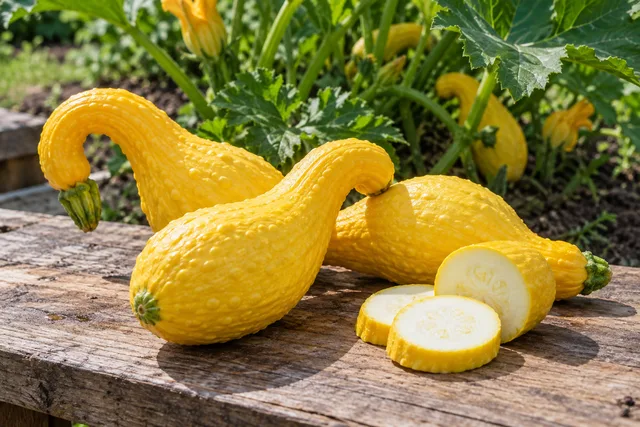
This image was created with AI from described plant characteristics and growing advice. It shows a possible situation and is not a photograph of a verified cultivar.
- Position
- Sun and shelter
- Space
- Circa 1 m² per struik; volg het ras
- Harvest
- Jong en regelmatig plukken
- Growing
- One growing season
This growing advice helps you choose. Your variety, growth stage, weather and conditions in your space determine the actual timing.
Sowing under cover and raising seedlings
Warm voorzaaien · Courgette
April–begin meiZaai warm binnen voor en reserveer voldoende lichte opkweekruimte.
- Germination and temperature
- Kiem warm, ongeveer 18–21 °C; voorkom koude, doorweekte zaaigrond.
- After emergence
- Zet zaailingen direct na opkomst licht. Een donkere zolder vraagt geschikte groeiverlichting; warmte alleen is onvoldoende. Ventileer en houd de grond vochtig, zonder haar te verzadigen.
- Pricking out and potting on
- Zaai in afzonderlijke potjes of diepe modules. Verspeen niet met kale wortels; zet de hele kluit over voordat de wortels vastlopen.
- Hardening off and planting out
- Laat binnen opgekweekte planten geleidelijk aan zon, wind en buitentemperatuur wennen; zet ze bij koude nachten weer beschut. Na de laatste vorst en na afharden, meestal eind mei–juni, met intacte kluit.
Deze planten groeien snel. Begin niet in februari als je pas eind mei kunt uitplanten.
Sources and use
RHS · courgette ↗Britse teeltrichtlijn voor een gematigd klimaat; de genoemde perioden zijn richtlijnen voor Nederland en Vlaanderen.
Feggies · Courgette Ola Redonda — ras- en teeltbeschrijving ↗Nederlandse producent of teeltbron; de rasinstructie blijft leidend.
Feggies · Courgette Black Beauty — ras- en teeltbeschrijving ↗Nederlandse producent of teeltbron; de rasinstructie blijft leidend.
Guideline periods for the Netherlands and Flanders. Check the variety, available light, soil and measured temperatures. Greenhouse heating does not guarantee enough winter light.
What makes Yellow Crookneck different?
- Vruchtvorm
- gebogen hals
- Groeiwijze
- vroeg
- Hoofdkleur
- heldergeel
The source context and any limitations are in the background information at the bottom.
Compare with another varietyFlavour and kitchen
Een exacte aromavergelijking is niet onderbouwd. Als zomerpompoen wordt hij jong gegeten voor een zachte schil en malse structuur.
This flavour description applies to the crop; a separate taste test for this variety is not supported by evidence.Snijd de gebogen vrucht in rondjes of korte stukken voor de pan. Combineer geel en groen in een eenvoudige zomerschotel.
Why choose it? Kies Yellow Crookneck voor de kleur en karakteristieke hals. De bron noemt vroege productie, aantrekkelijk voor wie een zomertype wil proberen.
Zo kun je courgette kweken
The options below belong to the plant. From these, choose the method that suits your variety's growth habit.
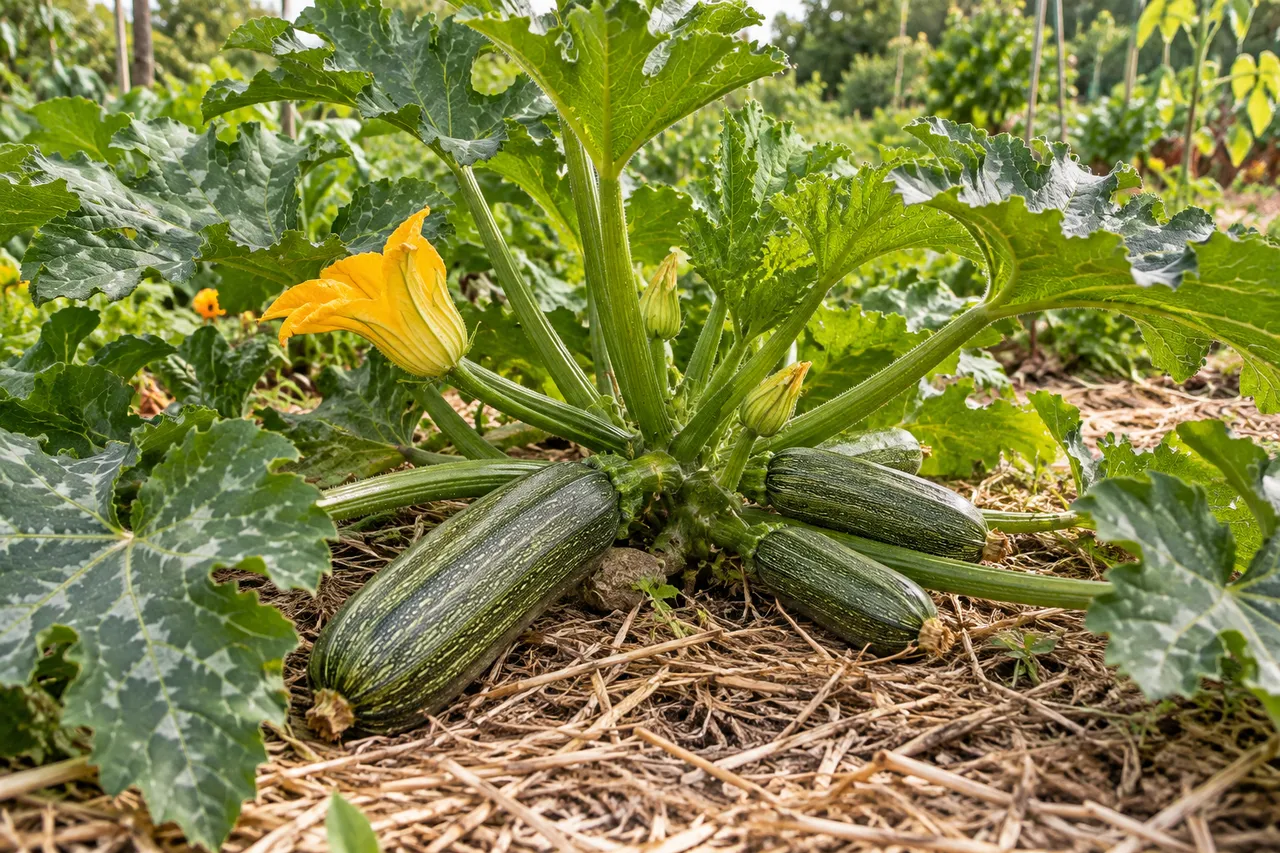
This image was created with AI from described plant characteristics and growing advice. It shows a possible situation and is not a photograph of a verified cultivar.
Vrij uitgroeien in een tuinbed
Een struikvorm spreidt zijn blad uit; een rankend ras krijgt extra grondruimte.
- Improve the soil with mature compost.
- Plant generously spaced and follow the instructions for your variety.
- Geef water bij de wortels en houd de plantvoet vrij van mulch.
Voor een ruim tuinbed.
Tick off your supplies →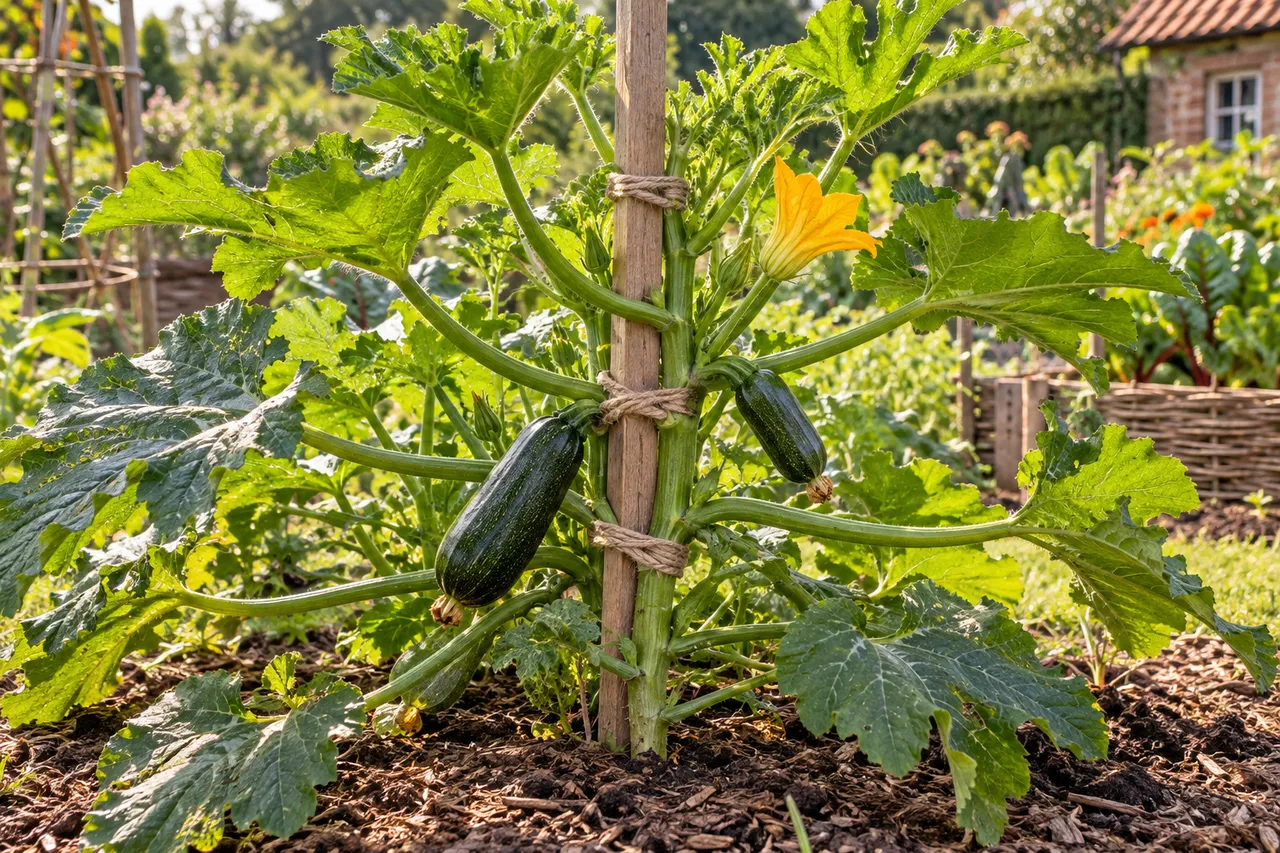
This image was created with AI from described plant characteristics and growing advice. It shows a possible situation and is not a photograph of a verified cultivar.
Support along a sturdy cane
Courgette klimt niet vanzelf. Bind de hoofdsteel voorzichtig en losjes aan.
- Plaats de steun vroeg en stevig.
- Bind aan de hoofdsteel met zacht materiaal.
- Controleer op knellen en maak de lus ruimer tijdens het groeien.
Choose a suitable growth habit; not every variety becomes a tall climber.
Tick off your supplies →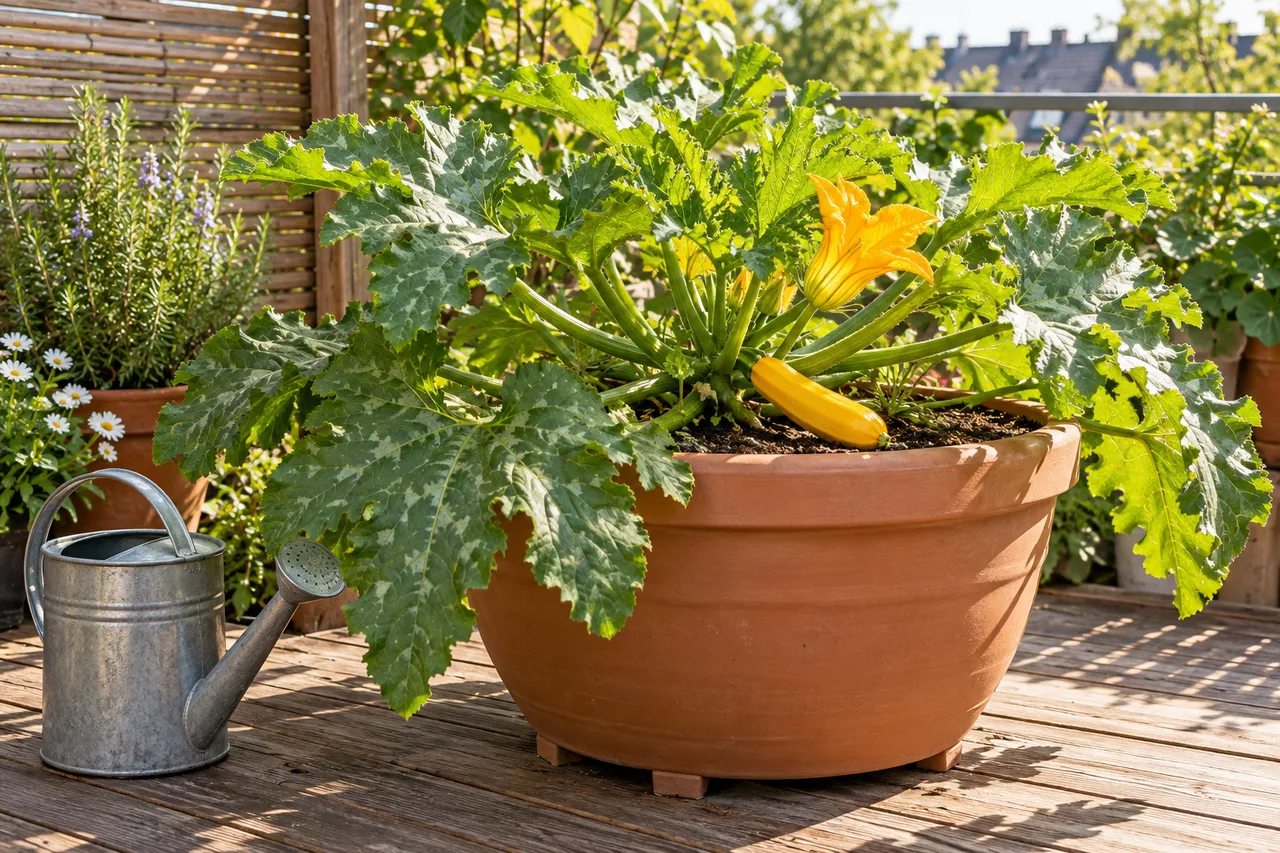
This image was created with AI from described plant characteristics and growing advice. It shows a possible situation and is not a photograph of a verified cultivar.
Een passende plant in een royale pot
Choose a variety suitable for pots and provide enough root room.
- Gebruik een pot van minstens 45 cm breed met afvoergaten.
- Zet één plant in geschikte potgrond.
- Kies zon en beschutting en controleer regelmatig water en voeding.
Voor een balkon of terras met ruimte voor uitwaaierend blad.
Tick off your supplies →Why grow Yellow Crookneck?
Heldergele vruchten met een gebogen hals geven deze oude zomerpompoen een heel eigen silhouette tussen rechte courgettes.
Kies Yellow Crookneck voor de kleur en karakteristieke hals. De bron noemt vroege productie, aantrekkelijk voor wie een zomertype wil proberen.
How this choice tastes
Een exacte aromavergelijking is niet onderbouwd. Als zomerpompoen wordt hij jong gegeten voor een zachte schil en malse structuur.
From harvest to kitchen
Snijd de gebogen vrucht in rondjes of korte stukken voor de pan. Combineer geel en groen in een eenvoudige zomerschotel.
What needs attention when growing
Geef dezelfde warme, voedzame en vorstvrije start als andere zomerpompoenen. Zorg dat de hals niet klem raakt tussen bladstelen.
Pluk jong en regelmatig. Laat de gele kleur niet misleiden: geel is het normale jonge rasbeeld, geen bewijs van overrijpheid.
Choose by flavour, shape and use
Ola Redonda: Round, light green courgettes with white speckles on a bushy plant: just the shape for small stuffed balls. Cut off a lid, hollow out the young fruit and fill with rice or vegetables. Include the scooped-out flesh in the filling.
No separate aroma is described. Harvesting young gives a tender courgette texture; the round shape is the clear cultivar difference here.
Black Beauty: The practical classic courgette: a non-vining plant for a regular summer harvest of young fruits. Cut young fruits lengthways for the barbecue or turn the harvest into soup. This gives both small and slightly larger specimens a place in the same kitchen.
The source advice centres on harvesting young for a tender texture. No specific sweetness relative to other green cultivars is documented.
Caserta: Light green, medium-length fruits with dark stripes make Caserta a fresh variation on uniformly green courgettes. Cut striped slices for a vegetable traybake or firm cubes for a quick stir-fry.
The firm flesh is described as good cooking quality. A separate claim about aroma or sweetness is absent; texture is the main distinction.
Cocozelle de Tripolis: Long, slender green courgettes with pale stripes; the classic elongated shape gains a visible pattern here. Cut fine, long slices for grilling or thin rounds for a summer vegetable dish.
The described flavour is mild. That mildness suits simple preparations in which the courgette remains recognisable.
Why grow your own courgettes?
You do not need a large vegetable bed to start with courgettes. One plant is already a good beginning: you see it change from a seedling into a broad plant with flowers and fruits. Looking beneath the leaves regularly during summer reveals exactly when there is something to pick.
Young fruits are versatile in the kitchen. Fry them briefly, grill slices or turn a generous harvest into soup. The flowers are edible too. Prefer male flowers for cooking and leave enough on the plant for pollination.
Sowing: start in April or May
For the Netherlands and Flanders, April to May is a practical period for starting indoors. This is guidance: work backwards from when you can plant out after the last night frost. Sowing too early produces large plants that still need to stay indoors for a long time.
Sow one seed per pot in moist seed compost, about 1–1.5 cm deep and on its side. Keep the pots warm, around 18–21 °C. After emergence, remove any lid and give the seedling plenty of light. Keep the compost moist without leaving the pot constantly wet.
Raising plants and acclimatising them gently
Courgettes grow quickly. Check that the pot still provides enough space and, if necessary, move the plant with its whole rootball into a larger pot. Pricking out from a shared tray is unnecessary if you sowed individually. Work carefully: damaged roots delay the start.
Before planting out, gradually acclimatise the plant to outdoor air, wind and sun. Start on a mild day in a sheltered spot and increase time outdoors. Bring it back inside on cold nights. A plant that has grown large indoors cannot immediately cope with everything outdoors.
Plant out once the cold has passed
Plant outdoors when the risk of night frost has passed and the soil has warmed. This is often from the second half of May or early June; your local forecast takes priority over the calendar. From late May or June, you can also sow directly outdoors.
Give the plant a sunny, sheltered spot. For an ordinary courgette, allow roughly 90 cm between plants or about one square metre. Some cultivars need more space. Set the rootball carefully in the planting hole and water to bring roots into contact with the soil.
A fertile bed, including on clay
Courgettes like soil that both retains moisture and lets excess water drain away. Mature compost helps prepare the bed. Do not put fresh manure close to young roots. Determine extra feeding from your soil and the product instructions; more is not automatically better.
On heavy clay, first look at where water remains after rain. Do not choose a low planting hole where the rootball stays wet. A well-drained bed, raised if necessary, gives a better starting point. Do not work wet clay into a smooth, smeared planting position.
Water and feeding: look at the soil first
Check the soil by the roots before watering. Water the soil so the root zone becomes properly moist; avoid a small daily splash that only reaches the surface. A pot dries out faster than a garden bed and needs more frequent checks in warm weather.
Mulch can help retain moisture once the soil is warm. Leave a little space around the stem. During fruit formation, give supplementary feed if necessary according to the packet. Record watering and feeding in My garden so you can see later what you actually did.
Recognising and pollinating flowers
A male flower stands on a thin stalk. Behind a female flower is already a small immature fruit: a miniature courgette. That little ball or cylinder is not yet a successful harvest. Pollen from a male flower must reach the female flower.
Bees and other insects help with this. In a closed greenhouse, reaching the flowers is difficult for them. Open the greenhouse in suitable weather; with few pollinators, you can gently transfer pollen from a fresh male flower to the female flower. Do this while the flowers are open.
Should you prune or train courgettes?
Most bush forms can simply be left to grow. Remove only badly damaged or diseased leaves when necessary. Leave healthy leaves in place: they help the plant grow. A climbing frame is not a fixed requirement for every courgette.
Costata Romanesco can spread more than a compact bush form. Choose the cultivar first, then reserve the space. A growth habit that fits easily in a large bed is not automatically a good choice for a small balcony pot.
If you want to grow upwards, place sturdy support beside the plant early and gently guide the main stem up. Tie loosely with soft material and check the loops during growth. A figure-of-eight tie separates stem and stake. The hollow stem is vulnerable: do not force an older plant or tie to a thin leaf stalk.
A supported bush courgette still grows differently from a true climbing cultivar and retains broad leaves. For standard courgettes, the RHS mentions a single sturdy stake about 1.8 metres long. Choose the growth habit deliberately and follow your own cultivar's spacing guidance. The growing illustrations above show how a garden bed, support and a large pot each need a different approach.
Harvesting: better young than impressively large
Usually pick elongated courgettes at about 15–20 cm, or smaller if preferred. For round cultivars, look at diameter; follow the cultivar description. Cut through the stalk with a clean knife or secateurs. Do not pull the fruit off the plant.
In good growing weather, look beneath the leaves every few days. A forgotten fruit can grow large quickly, with harder skin and coarser seeds. Regularly harvesting young fruits helps the plant continue producing.
Storing and using
Handle the harvest carefully: young skin damages easily. Preferably use courgettes within a few days and keep them cool. Before use, check for soft, rotting patches.
Have more than you can use straight away? Turn it into a dish you can freeze, such as soup or a vegetable stew. Before cooking, cut open an obviously oversized fruit and examine its skin and seeds. A large courgette has a different texture from the young harvest this variety is grown for.
What if the harvest disappoints?
Only flowers? The first are often male. Wait for female flowers to appear too. A small fruit turning yellow and dropping may indicate incomplete pollination, for example in cold weather or with few insects. Look at flowers and weather first, before adding fertiliser.
White, powdery patches on older leaves may be powdery mildew. Give plants air and avoid water stress. Yellow leaves have several possible causes: consider wet soil, drought and growth stage. A limp plant on a hot afternoon is no reason to water an already saturated bed again.
Saving your own seed? Start with reliable seed
Courgettes can cross with one another and with other forms of Cucurbita pepo. Seed from your own fruit therefore does not automatically reproduce the same cultivar. With F1 cultivars such as Eight Ball and Zephyr, offspring may differ even without such a cross. Choose reliable seed again for a predictable next crop.
Do not eat an unusually bitter courgette. Spit out a bitter mouthful and discard the fruit. Do not feed it to pets either. This is particularly a reason to be careful with unknown or home-saved courgette seed.
What you need
Tick what you already have. The extras depend on how you grow.
0 of 14 ticked off
Your ticks are saved in this browser.
Discover and grow more
More background, sources and image information
SeedSteps editorial team · updated on 11 October 2026. The AI images illustrate species and practical growing situations; they do not prove an exact cultivar, observations from your own garden or yield.
Britse gewasadviezen worden gecombineerd met Nederlandse en Vlaamse informatie waar beschikbaar. Amerikaanse Extension-bronnen ondersteunen plantprincipes en herkenning; hun kalenderdata, lokale plaagdruk, bestrijdingsmiddelen en mestdoseringen worden niet rechtstreeks op Nederland of Vlaanderen toegepast. Vorst, bodemwarmte, standplaats en expliciete rasinformatie blijven de lokale controle. Commerciële bronnen onderbouwen uitsluitend benoemde ras- en plantkenmerken; zij zijn geen affiliate-aanbeveling.
- World Checklist of Vascular Plants — 4 juni 2026Royal Botanic Gardens, Kew · accessed 2026-10-07
- Courgettes kweken — RHSRoyal Horticultural Society · accessed 2026-10-08
- Courgette Yellow Crookneck — ras- en teeltbeschrijvingFeggies · accessed 2026-10-11
- Klimcourgette Ola Escaladora — producentbeschrijvingDe Bolster · accessed 2026-10-11
- Courgette Black Beauty — ras- en teeltbeschrijvingFeggies · accessed 2026-10-11
- Courgette Caserta — ras- en teeltbeschrijvingFeggies · accessed 2026-10-11
- Courgette Cocozelle de Tripolis — ras- en teeltbeschrijvingFeggies · accessed 2026-10-11
- Courgette Geel — ras- en teeltbeschrijvingFeggies · accessed 2026-10-11
- Courgette mengeling — ras- en teeltbeschrijvingFeggies · accessed 2026-10-11
- Courgette Mutabile — ras- en teeltbeschrijvingFeggies · accessed 2026-10-11
- Courgette Ola Escaladora — ras- en teeltbeschrijvingFeggies · accessed 2026-10-11
- Courgette Ola Redonda — ras- en teeltbeschrijvingFeggies · accessed 2026-10-11
- Courgette Ronde de Nice — ras- en teeltbeschrijvingFeggies · accessed 2026-10-11
- Courgette Tabergmouzt uit Marokko — ras- en teeltbeschrijvingFeggies · accessed 2026-10-11
- Courgette Verte d’Italie — ras- en teeltbeschrijvingFeggies · accessed 2026-10-11
- Courgette wit uit Egypte — ras- en teeltbeschrijvingFeggies · accessed 2026-10-11
- Vorsicht beim Verzehr von bitteren ZucchiniBundesinstitut für Risikobewertung · accessed 2026-10-10
- Courgette Black BeautyDe Bolster · accessed 2026-10-10
- Costata Romanesco zucchini squashJohnny’s Selected Seeds · accessed 2026-10-10
- Cucurbita pepo Gold RushRoyal Horticultural Society · accessed 2026-10-10
- Courgettes: zaaien, verzorgen en oogstenRoyal Horticultural Society · accessed 2026-10-10
- Courgette, marrow and squash problemsRoyal Horticultural Society · accessed 2026-10-10
- Ondersteunen en achtvormig aanbindenRoyal Horticultural Society · accessed 2026-10-10
- Verticale groenteteelt en voorzichtig aanbindenRoyal Horticultural Society · accessed 2026-10-10
- Growing summer squash in a home gardenUniversity of Maryland Extension · accessed 2026-10-10
- Growing summer squash and zucchini in home gardensUniversity of Minnesota Extension · accessed 2026-10-10
- Summer and winter squash in the gardenUtah State University Extension · accessed 2026-10-10
Supporting evidence by chapter: Why grow Yellow Crookneck?: Feggies. How this choice tastes: Feggies. From harvest to kitchen: Feggies. What needs attention when growing: Feggies. Choose by flavour, shape and use: Feggies, Feggies, Feggies, Feggies. Why grow your own courgettes?: University of Minnesota Extension, Royal Horticultural Society. Sowing: start in April or May: Royal Horticultural Society, De Bolster. Raising plants and acclimatising them gently: Royal Horticultural Society, Utah State University Extension. Plant out once the cold has passed: Royal Horticultural Society, De Bolster. A fertile bed, including on clay: University of Minnesota Extension, Utah State University Extension. Water and feeding: look at the soil first: University of Maryland Extension, University of Minnesota Extension. Recognising and pollinating flowers: University of Minnesota Extension, Royal Horticultural Society. Should you prune or train courgettes?: Royal Horticultural Society, Johnny’s Selected Seeds, Royal Horticultural Society, Royal Horticultural Society. Harvesting: better young than impressively large: De Bolster, Royal Horticultural Society. Storing and using: Utah State University Extension, University of Maryland Extension. What if the harvest disappoints?: Royal Horticultural Society, Utah State University Extension. Saving your own seed? Start with reliable seed: Royal Horticultural Society, Royal Horticultural Society, Bundesinstitut für Risikobewertung.
Vruchtvorm: gebogen hals Beschrijving van de genoemde rasbron; geen eigen tuinwaarneming. Feggies
Groeiwijze: vroeg Beschrijving van de genoemde rasbron; geen eigen tuinwaarneming. Feggies
Hoofdkleur: heldergeel Beschrijving van de genoemde rasbron; geen eigen tuinwaarneming. Feggies