
Sweet potato: warmth above, tubers below
Sweet potato makes a lush carpet of vines while storage roots grow underground. You start with slips or young plants, not seed potatoes. A warm greenhouse and a large pot are practical trial spaces; outdoors, the crop needs a long, truly warm summer.
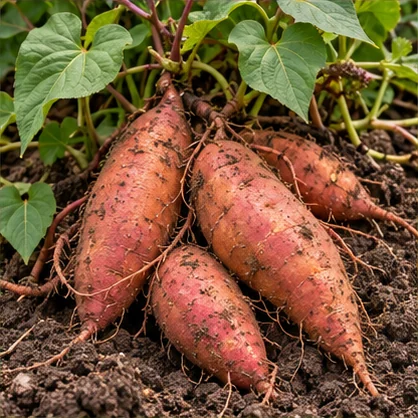
This image was created with AI from described plant characteristics and growing advice. It shows a possible situation and is not a photograph of a verified cultivar.
- Crop
- Ipomoea batatas; not an ordinary potato
- Start
- Rooted shoots or young plants
- Heat
- Frost-free and warm for a long period; outdoor yields can vary
- Harvest
- Before cold and frost; lift storage roots carefully
This growing advice helps you choose. Your variety, growth stage, weather and conditions in your space determine the actual timing.
Sowing under cover and raising seedlings
Raise cuttings or young plants · Sweet potato
Spring, according to delivery and propagation guidanceGrow suitable rooted cuttings or young plants in warm, bright conditions.
- Germination and temperature
- A warm, bright propagation space and warm soil later are needed.
- After emergence
- Give seedlings light immediately after emergence. A dark loft needs suitable grow lights; warmth alone is insufficient. Ventilate and keep the compost moist without saturating it.
- Pricking out and potting on
- Carefully pot on rooted cuttings when the root ball needs more space. This is not the planting-stock route for ordinary potatoes.
- Hardening off and planting out
- Gradually acclimatise indoor-raised plants to sun, wind and outdoor temperatures; shelter them again on cold nights. Plant rooted cuttings only after frost with sufficient warmth; a greenhouse gives a better chance of a warm season.
This is not an ordinary potato. Use suitable cuttings; a supermarket tuber gives no certainty about cultivar or suitability.
Sources and use
Royal Horticultural Society · RHS — zoete-aardappel kweken ↗Soort- of productgebonden bron; buitenlandse perioden zijn geen vaste Nederlandse zaaidatum.
Utah State University Extension · USU Extension — zoete-aardappel in de tuin ↗Soort- of productgebonden bron; buitenlandse perioden zijn geen vaste Nederlandse zaaidatum.
Guideline periods for the Netherlands and Flanders. Check the variety, available light, soil and measured temperatures. Greenhouse heating does not guarantee enough winter light.
Choose your way to grow
From a garden bed to a suitable pot or support: give your plant a place that suits your garden and the care you can provide.
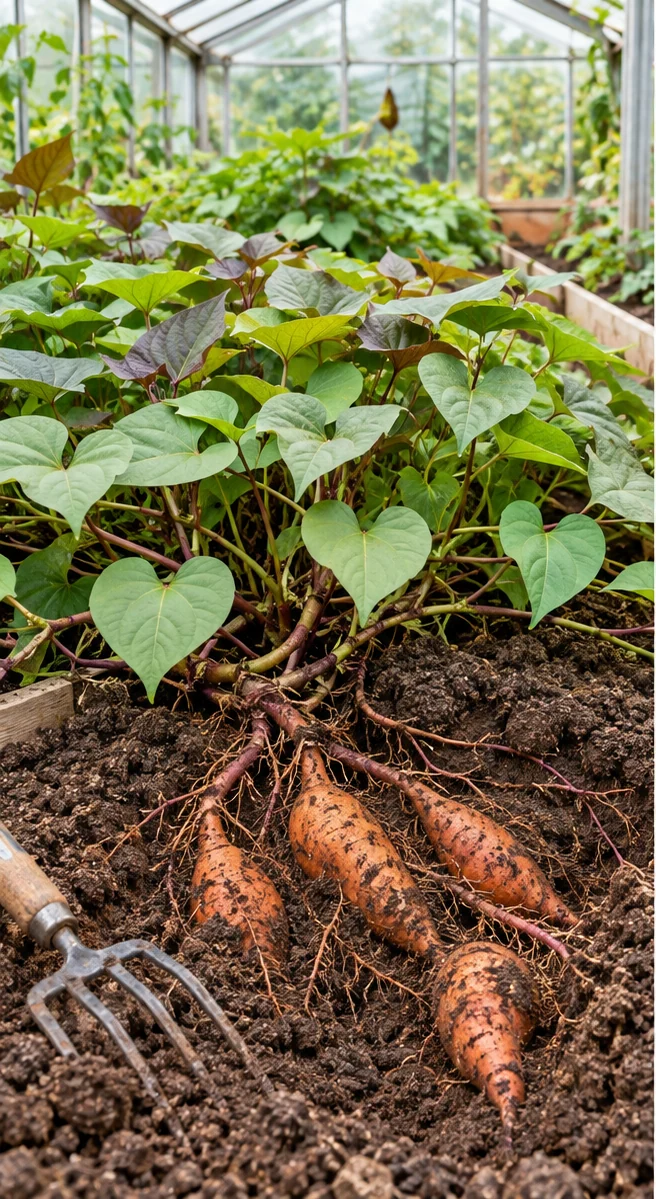
This image was created with AI from described plant characteristics and growing advice. It shows a possible situation and is not a photograph of a verified cultivar.
A warm greenhouse bed with trailing vines
A greenhouse provides extra warmth for a long growing season. Let vines run across the bed and reserve space for careful harvesting later.
- Use rooted shoots or healthy young plants of a suitable edible variety.
- Plant in warm, loose greenhouse soil after frost risk and water.
- Let vines cover the bed without completely overwhelming other crops.
- Lift storage roots at the end, well away from the plant base.
For extra warmth and greater soil volume than a small pot.
Tick off your supplies →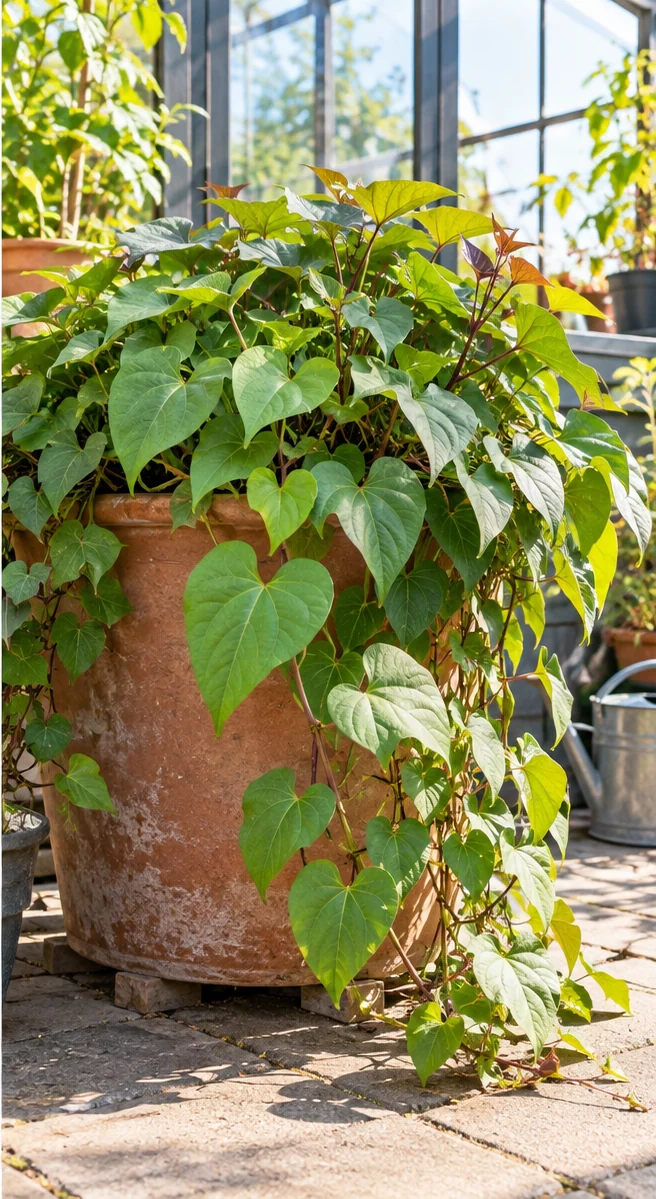
This image was created with AI from described plant characteristics and growing advice. It shows a possible situation and is not a photograph of a verified cultivar.
A large pot in the warmest position
A large container can warm up more and makes harvesting manageable. Soil volume and the length of the warm period limit yield.
- Choose a pot at least approximately 30 cm wide, preferably larger and deep, with drainage.
- Plant one young plant or a suitable quantity according to variety advice in fertile compost.
- Keep the pot warm and sunny; do not move vulnerable plants outdoors too early.
- Keep moisture consistent and carefully loosen the whole rootball at harvest.
For a warm patio or greenhouse; treat it as a growing trial without guaranteed kilos.
Tick off your supplies →A different crop from seed potatoes
Sweet potato belongs to Ipomoea, while ordinary potato is Solanum. Edible underground parts are swollen storage roots. Potato ridges for preventing green potato tubers are therefore unnecessary. Start with this crop's specific method and planting material.
Choose rooted shoots for a predictable start
Commercially supplied slips or young plants offer a practical start. Raising shoots from a shop-bought tuber can be an experiment, but variety, treatment and suitability for our season are often unknown. Ornamental Ipomoea is not an automatic substitute for a suitable edible variety.
Reserve the longest warm window
The plant is frost-sensitive and actively grows in warmth. Plant outdoors only in warm soil after local frost risk. A greenhouse improves the chance of a long season. Utah calendars describe different conditions and promise no fixed Dutch yield or date.
Give roots a loose foundation
Put rooted young plants into airy soil and follow planting depth for the material. Keep leaves and growing point above soil. Water immediately to settle the root ball. Provide drainage so warmth does not coincide with suffocating wet roots.
Trailing growth is not proof of yield
Healthy foliage shows growth but not the number of storage roots beneath. Give vines space and guide away from paths if needed. Careful training along support saves space; harvests still form in the bed or compost.
Check supplies in the pot
Water consistently during growth and avoid big swings between bone dry and soaking wet. Pots have limited reserves. Fertilise to suit the soil or potting compost; excess nitrogen can produce lots of foliage. Extra feeding does not make a cold position suitable for a warmth-loving crop.
Recognise cold and wet soil early
Slow growth can reflect low temperatures or wet roots. Check position and soil before feeding. Watch feeding damage and leaf problems too. Ventilate greenhouses on hot days and handle long vines carefully when watering or moving.
Dig widely and keep the skin intact
Harvest before frost and prolonged cold damage the crop. Loosen soil outside the plant base and find storage roots carefully. Thin fresh skin damages easily: do not pull hard on one root or throw harvests into crates.
Fresh harvesting needs a suitable next step
Use damaged specimens first. Commercial storage includes controlled warm, humid curing followed by appropriate storage; random cold sheds do not substitute. Follow reliable home-storage advice and assess quality regularly. Refrigerator cold poorly suits this tropical crop.
What you need
Tick what you already have. The extras depend on how you grow.
0 of 6 ticked off
Your ticks are saved in this browser.
Discover and grow more
More background, sources and image information
SeedSteps editorial team · updated on 11 October 2026. The AI images illustrate species and practical growing situations; they do not prove an exact cultivar, observations from your own garden or yield.
Britse gewasadviezen worden gecombineerd met Nederlandse en Vlaamse informatie waar beschikbaar. Amerikaanse Extension-bronnen ondersteunen plantprincipes en herkenning; hun kalenderdata, lokale plaagdruk, bestrijdingsmiddelen en mestdoseringen worden niet rechtstreeks op Nederland of Vlaanderen toegepast. Vorst, bodemwarmte, standplaats en expliciete rasinformatie blijven de lokale controle. Commerciële bronnen onderbouwen uitsluitend benoemde ras- en plantkenmerken; zij zijn geen affiliate-aanbeveling.
- World Checklist of Vascular Plants — 4 juni 2026Royal Botanic Gardens, Kew · accessed 2026-10-07
- RHS — zoete-aardappel kwekenRoyal Horticultural Society · accessed 2026-10-10
- USU Extension — zoete-aardappel in de tuinUtah State University Extension · accessed 2026-10-10
Supporting evidence by chapter: A different crop from seed potatoes: Royal Horticultural Society, Utah State University Extension. Choose rooted shoots for a predictable start: Royal Horticultural Society, Utah State University Extension. Reserve the longest warm window: Royal Horticultural Society, Utah State University Extension. Give roots a loose foundation: Royal Horticultural Society, Utah State University Extension. Trailing growth is not proof of yield: Royal Horticultural Society, Utah State University Extension. Check supplies in the pot: Royal Horticultural Society, Utah State University Extension. Recognise cold and wet soil early: Royal Horticultural Society, Utah State University Extension. Dig widely and keep the skin intact: Royal Horticultural Society, Utah State University Extension. Fresh harvesting needs a suitable next step: Royal Horticultural Society, Utah State University Extension.