
Timperley Early: een plek in jouw tuin
Ontdek Timperley Early en kies hoe je rabarber wilt kweken. Hieronder staan de bevestigde rasgegevens en de praktische teeltgids voor deze groente.
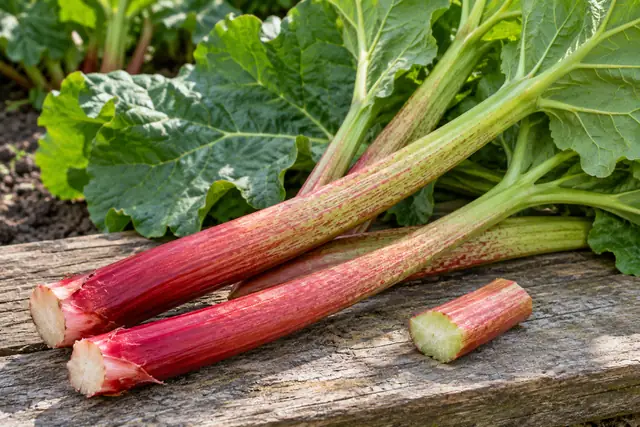
This image was created with AI from described plant characteristics and growing advice. It shows a possible situation and is not a photograph of a verified cultivar.
- Lifespan
- Perennial; reserve permanent space
- Location
- Sun or light partial shade, fertile soil without standing water
- Start
- Crown, division or young plant of an edible rhubarb
- Patience
- Do not harvest in the first growing year; build up cautiously afterwards
This growing advice helps you choose. Your variety, growth stage, weather and conditions in your space determine the actual timing.
Sowing under cover and raising seedlings
Perennial growing: young plants, divisions or seed · Rhubarb
Spring for suitable planting stock; follow species and supplierPlant suitable stock, crowns or divisions in workable soil. This is not a general sowing route.
- Germination and temperature
- Germination requirements differ by species. Follow the packet; germination of Good King Henry can be slow and irregular.
- After emergence
- Give emerged plants light, prevent drying out and allow a healthy root ball to develop.
- Pricking out and potting on
- Prick out seedlings only when manageable. Plant bought stock or divisions with roots intact.
- Hardening off and planting out
- Gradually acclimatise indoor-raised plants to sun, wind and outdoor temperatures; shelter them again on cold nights. Choose a suitable permanent position. Plant asparagus crowns and rhubarb divisions according to their own planting guidance.
Not all perennial plants yield a harvest in their first year. Choose healthy planting stock for a predictable start; seedlings can vary.
Sources and use
RHS · asperge ↗Britse teeltrichtlijn voor een gematigd klimaat; de genoemde perioden zijn richtlijnen voor Nederland en Vlaanderen.
Royal Horticultural Society · RHS — rabarber kweken ↗Soort- of productgebonden bron; buitenlandse perioden zijn geen vaste Nederlandse zaaidatum.
University of Minnesota Extension · UMN Extension — rabarber in de moestuin ↗Soort- of productgebonden bron; buitenlandse perioden zijn geen vaste Nederlandse zaaidatum.
Guideline periods for the Netherlands and Flanders. Check the variety, available light, soil and measured temperatures. Greenhouse heating does not guarantee enough winter light.
How to grow rhubarb
The options below belong to the plant. From these, choose the method that suits your variety's growth habit.
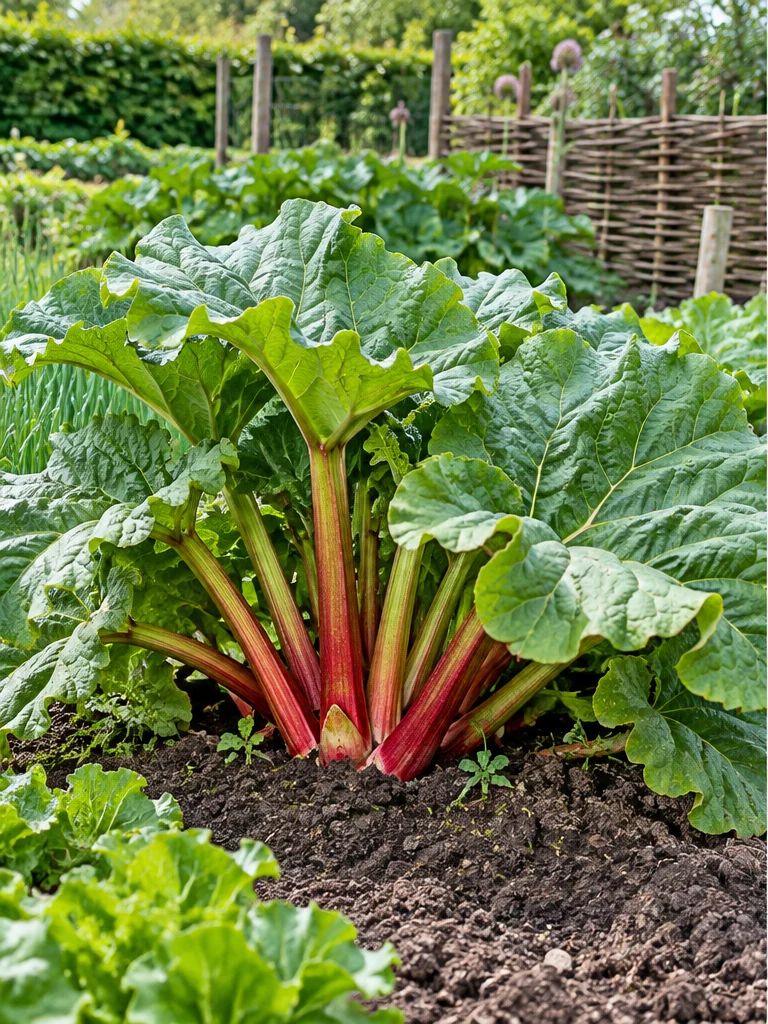
This image was created with AI from described plant characteristics and growing advice. It shows a possible situation and is not a photograph of a verified cultivar.
A generous permanent corner
An established rhubarb plant can form a substantial canopy. Put it at the edge of the vegetable garden so that annual crop rotation can move around it.
- Remove perennial weeds and improve a broad area with mature compost.
- Plant the crown with buds at or just above soil level according to planting instructions.
- Water in dry weather and leave all initial growth intact.
- Harvest only from a well-established plant and always leave many healthy stalks.
For a long crop, with enough room for mature foliage.
Tick off your supplies →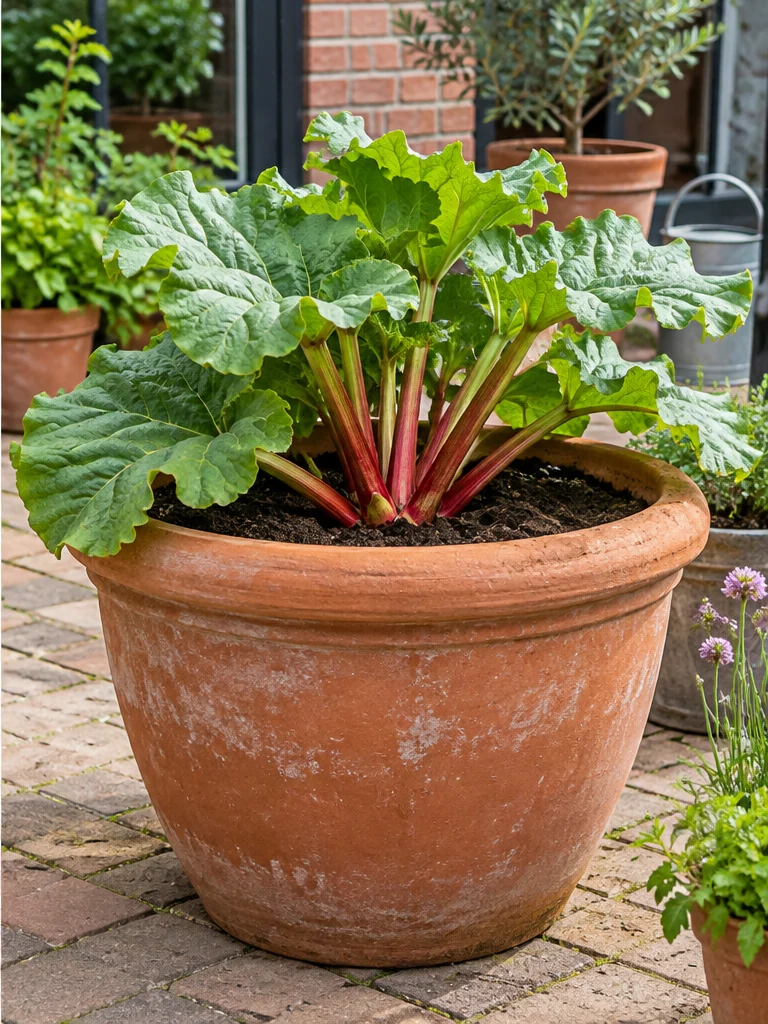
This image was created with AI from described plant characteristics and growing advice. It shows a possible situation and is not a photograph of a verified cultivar.
A compact plant in a large pot
A compact variety can grow temporarily or longer in a generous container. Container growing needs extra attention to water, nutrients and root space.
- Choose a pot approximately 50 cm wide and deep with generous drainage holes.
- Use fertile compost and plant the crown with buds exposed.
- Water evenly and feed according to compost or fertiliser instructions.
- Harvest modestly and repot or divide when the plant outgrows its pot.
For a spacious patio; yield may be lower than in open ground.
Tick off your supplies →Choose by flavour, shape and use
Rood: This seed offering is named red rhubarb. Seedlings do not guarantee a uniform, division-propagated variety identity. Use stalks for compote or tart. Leaves are not for the kitchen; process only suitable stalks.
Rhubarb is acidic as a crop. Red colour proves no greater sweetness, and the source confirms no distinct variety aroma.
Plan for the mature canopy of leaves
Allow roughly a square metre or the variety's required space. Keep rhubarb outside annual digging and sowing routines. Light partial shade can work, but a dark, dry corner gives less growth. Rainwater must drain away.
A crown gives a predictable start
Use a healthy crown, division or potted edible rhubarb. Seed is possible, but offspring need not share parental traits. Plant in suitable calm weather and follow depth instructions for a purchased crown.
Plenty of foliage needs a well-tended base
Place mature compost around the plant, keeping central buds clear. On heavy, wet soil, a raised bed can help. Airy mulch around the crown retains moisture; a constantly wet heap on top instead increases rot risk.
Help the root system during dry periods
Young plants cannot yet rely on large root systems. Water deeply in drought and check larger plants during leaf growth too. Pots dry faster. Wilting on a warm afternoon calls for a soil check before automatic extra watering.
Let the plant invest in growth first
Skip harvesting in the first growing year. Afterwards, take only a little during vigorous growth. Build up harvesting, but remove no more than about a third of stalks each time. Leaves maintain root reserves.
Gently pull a stalk free
Choose firm, developed leaf stalks. Hold low and pull with a small twist to detach from the base without damaging the crown. Stop normal harvesting around early summer for recovery. The leaf blade is not edible.
A dark spring as an extra experiment
An established healthy plant can be covered with an opaque rhubarb pot in late winter for pale early stalks. Forcing uses energy. Do not force young plants; afterwards give the same crown a full season's rest without repeat forcing.
Recognise flowering and ageing
Remove a flower stalk low down if growing for leaf stalks. Divide an oversized or less vigorous plant during suitable dormancy, with healthy buds per division. Dig widely around the crown and replant in improved soil.
Check the crown if growth is poor
Wet soil, an overburied crown or excessive harvesting can weaken plants. Inspect the base if rot or unexpected collapse occurs and improve drainage. Do not divide diseased crowns. Healthy stalks do not mean rhubarb leaves are edible.
What you need
Tick what you already have. The extras depend on how you grow.
0 of 5 ticked off
Your ticks are saved in this browser.
Discover and grow more
More background, sources and image information
SeedSteps editorial team · updated on 11 October 2026. The AI images illustrate species and practical growing situations; they do not prove an exact cultivar, observations from your own garden or yield.
Britse gewasadviezen worden gecombineerd met Nederlandse en Vlaamse informatie waar beschikbaar. Amerikaanse Extension-bronnen ondersteunen plantprincipes en herkenning; hun kalenderdata, lokale plaagdruk, bestrijdingsmiddelen en mestdoseringen worden niet rechtstreeks op Nederland of Vlaanderen toegepast. Vorst, bodemwarmte, standplaats en expliciete rasinformatie blijven de lokale controle. Commerciële bronnen onderbouwen uitsluitend benoemde ras- en plantkenmerken; zij zijn geen affiliate-aanbeveling.
- World Checklist of Vascular Plants — 4 juni 2026Royal Botanic Gardens, Kew · accessed 2026-10-07
- Common catalogue of varieties of vegetable species — 27 januari 2023Europese Commissie · accessed 2026-10-07
- Rabarber Rood zaden biologischFeggies · accessed 2026-10-11
- Rhubarb: cultivation and harvestingRoyal Horticultural Society · accessed 2026-10-11
- RHS — rabarber kwekenRoyal Horticultural Society · accessed 2026-10-10
- UMN Extension — rabarber in de moestuinUniversity of Minnesota Extension · accessed 2026-10-10
Supporting evidence by chapter: Choose by flavour, shape and use: Feggies, Royal Horticultural Society. Plan for the mature canopy of leaves: Royal Horticultural Society, University of Minnesota Extension. A crown gives a predictable start: Royal Horticultural Society, University of Minnesota Extension. Plenty of foliage needs a well-tended base: Royal Horticultural Society, University of Minnesota Extension. Help the root system during dry periods: Royal Horticultural Society, University of Minnesota Extension. Let the plant invest in growth first: Royal Horticultural Society, University of Minnesota Extension. Gently pull a stalk free: Royal Horticultural Society, University of Minnesota Extension. A dark spring as an extra experiment: Royal Horticultural Society, University of Minnesota Extension. Recognise flowering and ageing: Royal Horticultural Society, University of Minnesota Extension. Check the crown if growth is poor: Royal Horticultural Society, University of Minnesota Extension.