
Eight Ball: a round courgette for stuffing
Eight Ball is a round, dark green F1 courgette. Pick it young, about the size of a billiard ball, or use the round shape as a starting point for stuffing.
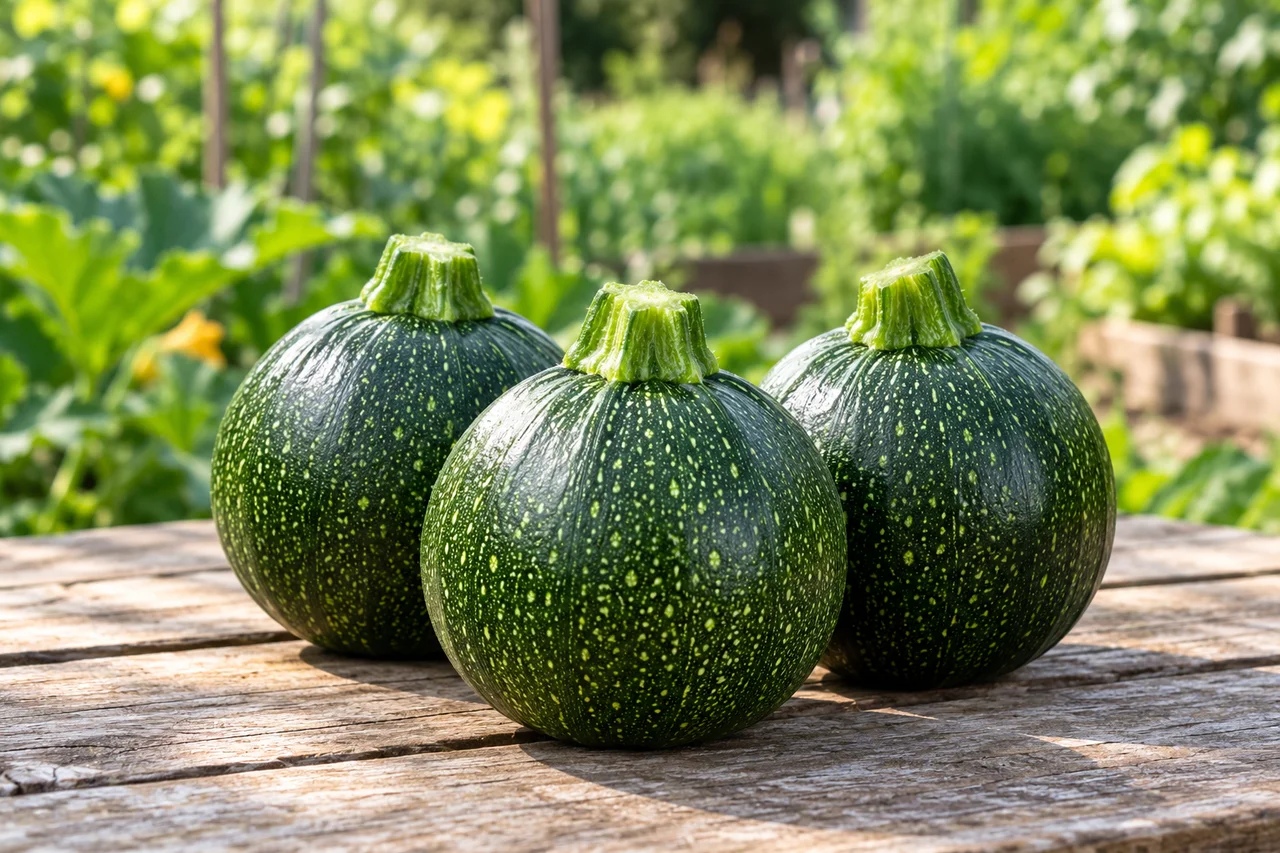
This image was created with AI from described plant characteristics and growing advice. It shows a possible situation and is not a photograph of a verified cultivar.
- Position
- Sunny and sheltered
- Space
- circa 76 cm volgens AAS
- Harvest
- Round · dark green · F1
- Growing
- One growing season
Growing periods are guidelines for the Netherlands and Flanders. The last frost, warmth and your own growing space determine the timing. Read the courgette guide too for full care instructions.
Sowing under cover and raising seedlings
Start under cover in warmth · Courgette
April–early MayStart indoors in warmth and reserve enough bright space for raising plants.
- Germination and temperature
- Germinate in warmth, around 18–21 °C; avoid cold, waterlogged seed compost.
- After emergence
- Give seedlings light immediately after emergence. A dark loft needs suitable grow lights; warmth alone is insufficient. Ventilate and keep the compost moist without saturating it.
- Pricking out and potting on
- Sow in individual pots or deep modules. Do not prick out bare-rooted; move the whole root ball before the roots become restricted.
- Hardening off and planting out
- Gradually acclimatise indoor-raised plants to sun, wind and outdoor temperatures; shelter them again on cold nights. After the last frost and hardening off, usually late May–June, with the root ball intact.
These plants grow quickly. Do not start in February if you cannot plant out until late May.
Sources and use
RHS · courgette ↗Britse teeltrichtlijn voor een gematigd klimaat; de genoemde perioden zijn richtlijnen voor Nederland en Vlaanderen.
Feggies · Courgette Ola Redonda — ras- en teeltbeschrijving ↗Nederlandse producent of teeltbron; de rasinstructie blijft leidend.
Feggies · Courgette Black Beauty — ras- en teeltbeschrijving ↗Nederlandse producent of teeltbron; de rasinstructie blijft leidend.
Guideline periods for the Netherlands and Flanders. Check the variety, available light, soil and measured temperatures. Greenhouse heating does not guarantee enough winter light.
How to recognise Eight Ball
Shape is the first striking feature: round rather than elongated. All-America Selections describes dark green, speckled fruit and a bush plant. The variety won a 1999 AAS award in North American trials.
Choose the spot before you sow
AAS mentions about 76 cm for plant spread and spacing. This is a source value from North American trials, not a guarantee for your bed. Allow room to harvest without stepping on leaves.
Mark the spot in your garden planner now. Leave a path clear too: you will need to reach the flowers and fruit stalks later. Measure the available space now rather than after planting out.
From seed to a young plant
For our outdoor summer season, usually start in April or May in an individual pot. The exact start depends on when you can safely plant out. Buy seed under the exact cultivar name and write that name on the label; this keeps different cultivars distinguishable.
Gradual hardening off and planting out
First let your plant get used to outdoor air and sunshine. Wait to plant out until the risk of night frost has passed and the bed is warm enough. Move the whole root ball carefully. A quick start comes from suitable conditions rather than putting plants outside as early as possible.
Care with attention to the roots
Check the soil regularly and water at the roots. If the soil is still wet, skip watering. Record what you do and watch how the plant responds. For the full step-by-step guide to water, soil and feeding, return to the courgette guide.
Flowers are the start of the harvest
When the first flowers appear, check whether there is a small ovary behind them. A flower on a thin stalk is male. Allow pollinating insects access to the flowers, even in a greenhouse or under protection. A small fruit that fails to grow first calls for a check of pollination and conditions.
When do you pick this cultivar?
For young harvests, AAS mentions a diameter of around 5–7.5 cm. Do not let every fruit keep growing just to make it larger. For stuffing, try a small fruit first and adapt the dish to its actual size.
Save your first harvest date in My garden. This gives you a personal reminder of the season and lets you look back later at which fruits you wanted to pick again.
A choice for next season
This is an F1 variety. Saved seed does not reliably reproduce the same traits. Keep the variety name on your wishlist and choose its seed again for a predictable next crop.
Judge the cultivar by what matters to you: its shape in the kitchen, ease of harvesting or the space the plant needed. The AI illustration helps you explore its appearance; your own photos and harvest records show how growing it actually went.
Continue with courgettes
More background, sources and image information
Courgette belongs to Cucurbita pepo, in the cucumber family. The producer describes Zephyr as a bicoloured summer squash. General growing advice has been adapted to our home gardening context; foreign spacing recommendations and variety characteristics remain clearly attributed to their sources.
SeedSteps editorial team · updated . The images were created with AI and illustrate the features described.
- World Checklist of Vascular Plants — 4 juni 2026Royal Botanic Gardens, Kew · accessed 2026-10-07
- Squash Eight Ball F1All-America Selections · accessed 2026-10-10
- Common catalogue of varieties of vegetable species — 27 januari 2023Europese Commissie · accessed 2026-10-07
- Klimcourgette Ola Escaladora — producentbeschrijvingDe Bolster · accessed 2026-10-11
- Courgette Black Beauty — ras- en teeltbeschrijvingFeggies · accessed 2026-10-11
- Courgette Caserta — ras- en teeltbeschrijvingFeggies · accessed 2026-10-11
- Courgette Cocozelle de Tripolis — ras- en teeltbeschrijvingFeggies · accessed 2026-10-11
- Courgette Geel — ras- en teeltbeschrijvingFeggies · accessed 2026-10-11
- Courgette mengeling — ras- en teeltbeschrijvingFeggies · accessed 2026-10-11
- Courgette Mutabile — ras- en teeltbeschrijvingFeggies · accessed 2026-10-11
- Courgette Ola Escaladora — ras- en teeltbeschrijvingFeggies · accessed 2026-10-11
- Courgette Ola Redonda — ras- en teeltbeschrijvingFeggies · accessed 2026-10-11
- Courgette Ronde de Nice — ras- en teeltbeschrijvingFeggies · accessed 2026-10-11
- Courgette Tabergmouzt uit Marokko — ras- en teeltbeschrijvingFeggies · accessed 2026-10-11
- Courgette Verte d’Italie — ras- en teeltbeschrijvingFeggies · accessed 2026-10-11
- Courgette wit uit Egypte — ras- en teeltbeschrijvingFeggies · accessed 2026-10-11
- Courgette Yellow Crookneck — ras- en teeltbeschrijvingFeggies · accessed 2026-10-11
- Pâtisson Oranje — ras- en teeltbeschrijvingFeggies · accessed 2026-10-11
- Pâtisson panaché — ras- en teeltbeschrijvingFeggies · accessed 2026-10-11
- Pâtisson wit — ras- en teeltbeschrijvingFeggies · accessed 2026-10-11
- Courgettes: zaaien, verzorgen en oogstenRoyal Horticultural Society · accessed 2026-10-10
- Courgette, marrow and squash problemsRoyal Horticultural Society · accessed 2026-10-10
- Growing summer squash in a home gardenUniversity of Maryland Extension · accessed 2026-10-10
- Growing summer squash and zucchini in home gardensUniversity of Minnesota Extension · accessed 2026-10-10
- Summer and winter squash in the gardenUtah State University Extension · accessed 2026-10-10
Supporting evidence by chapter: How to recognise Eight Ball: All-America Selections. Choose the spot before you sow: All-America Selections, Utah State University Extension. From seed to a young plant: Royal Horticultural Society. Gradual hardening off and planting out: Royal Horticultural Society, Utah State University Extension. Care with attention to the roots: University of Minnesota Extension. Flowers are the start of the harvest: Royal Horticultural Society. When do you pick this cultivar?: All-America Selections, University of Maryland Extension. A choice for next season: Royal Horticultural Society, All-America Selections.