
Algarve: een plek in jouw tuin
Ontdek Algarve en kies hoe je stokboon wilt kweken. Hieronder staan de bevestigde rasgegevens en de praktische teeltgids voor deze groente.
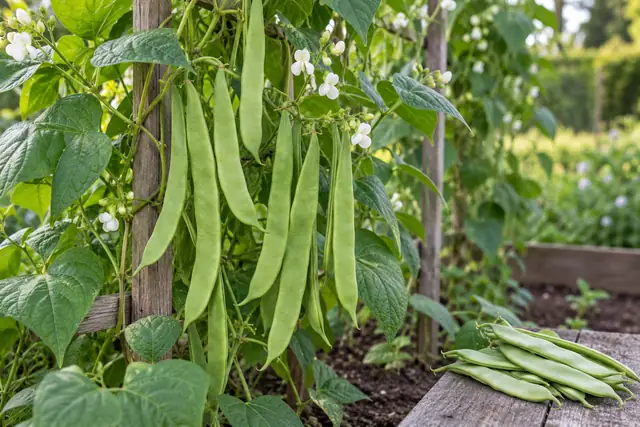
This image was created with AI from described plant characteristics and growing advice. It shows a possible situation and is not a photograph of a verified cultivar.
- Sowing
- Na vorst, in voldoende warme grond
- Location
- Zon en goede afwatering
- Support
- Stevig hoog rek
- Harvesting
- Volg het gebruik van je ras: jonge peul of rijpe boon
This growing advice helps you choose. Your variety, growth stage, weather and conditions in your space determine the actual timing.
Sowing under cover and raising seedlings
Kort voorzaaien of direct zaaien · Climbing bean
Eind april–meiZaai kort voor in afzonderlijke potjes. Zorg dat je na enkele weken warm kunt uitplanten.
- Germination and temperature
- Zaai warm; koude, langdurig natte grond vergroot de kans op uitval.
- After emergence
- Zet zaailingen direct na opkomst licht. Een donkere zolder vraagt geschikte groeiverlichting; warmte alleen is onvoldoende. Ventileer en houd de grond vochtig, zonder haar te verzadigen.
- Pricking out and potting on
- Zaai in afzonderlijke potjes of diepe modules. Verspeen niet met kale wortels; zet de hele kluit over voordat de wortels vastlopen.
- Hardening off and planting out
- Laat binnen opgekweekte planten geleidelijk aan zon, wind en buitentemperatuur wennen; zet ze bij koude nachten weer beschut. Plant na de laatste vorst uit met de hele kluit; plaats steun vooraf bij klimmende typen.
Begin voor buitenplanten niet maanden te vroeg. Bonen groeien snel en verdragen geen vorst.
Sources and use
Royal Horticultural Society · RHS — boon kweken ↗Soort- of productgebonden bron; buitenlandse perioden zijn geen vaste Nederlandse zaaidatum.
University of Minnesota Extension · UMN Extension — boon in de moestuin ↗Soort- of productgebonden bron; buitenlandse perioden zijn geen vaste Nederlandse zaaidatum.
Guideline periods for the Netherlands and Flanders. Check the variety, available light, soil and measured temperatures. Greenhouse heating does not guarantee enough winter light.
Zo kun je stokboon kweken
The options below belong to the plant. From these, choose the method that suits your variety's growth habit.
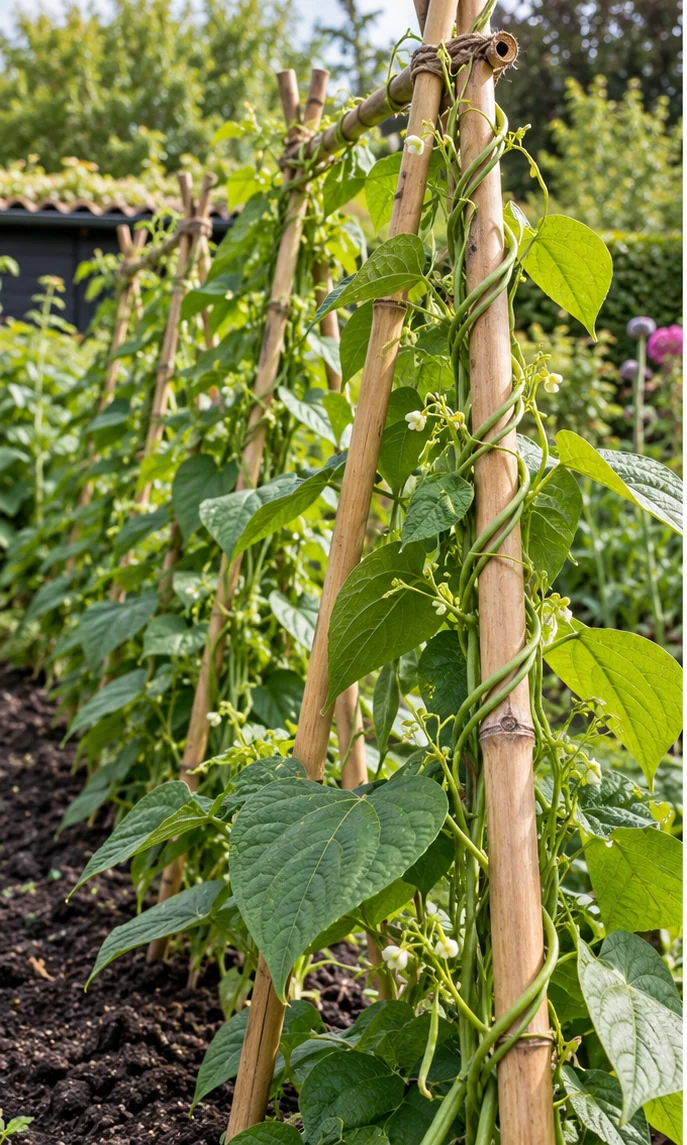
This image was created with AI from described plant characteristics and growing advice. It shows a possible situation and is not a photograph of a verified cultivar.
Een rij langs een rek
Een stevig rek brengt de oogst omhoog. Laat beide kanten bereikbaar en plaats de steun voor het zaaien, zodat je later geen stokken tussen de wortels hoeft te duwen.
- Veranker stokken met een dwarsschoor.
- Zaai op de aanbevolen afstand van het ras.
- Controleer opkomst, wortelvocht en jonge peulen.
For anyone with a sunny outdoor bed.
Tick off your supplies →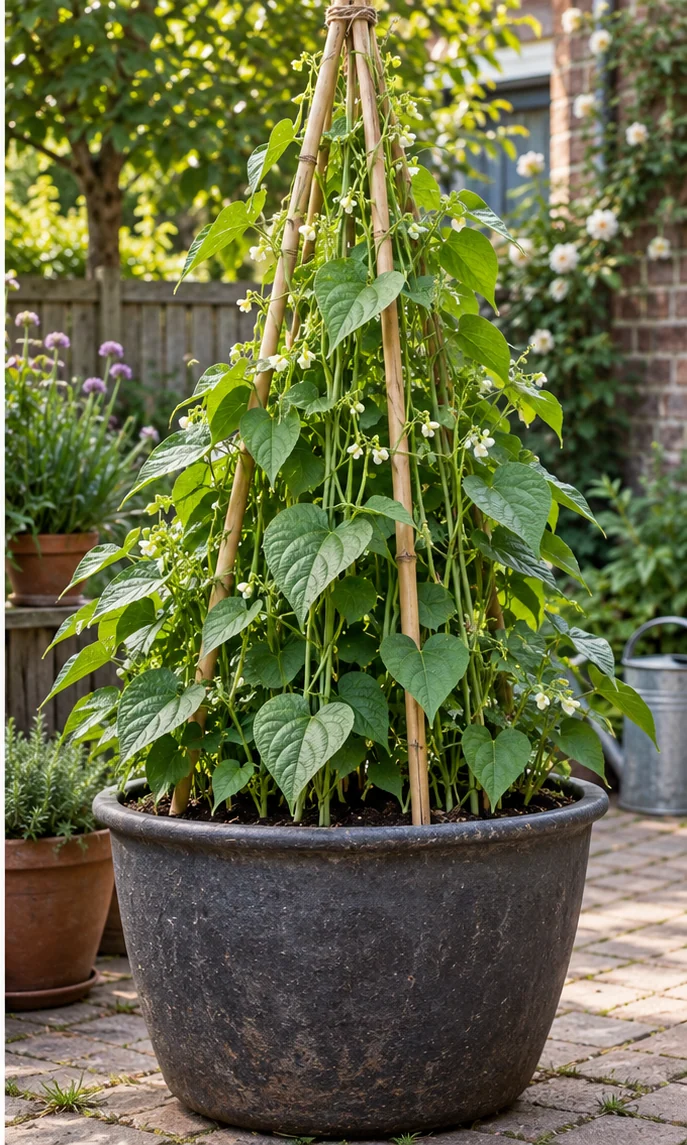
This image was created with AI from described plant characteristics and growing advice. It shows a possible situation and is not a photograph of a verified cultivar.
Een klimmer in een stabiele kuip
Een begroeid bonenrek vangt wind. Gebruik een grote, zware kuip en een verankerde steun, en houd de kluit vochtig tijdens de peulvorming.
- Zet de kuip en steun stabiel vast.
- Gebruik geschikte potgrond met vrije afwatering.
- Pluk voorzichtig en voel bij warmte dagelijks aan de grond.
Voor een beschut balkon of terras met ruimte voor de gekozen groeiwijze.
Tick off your supplies →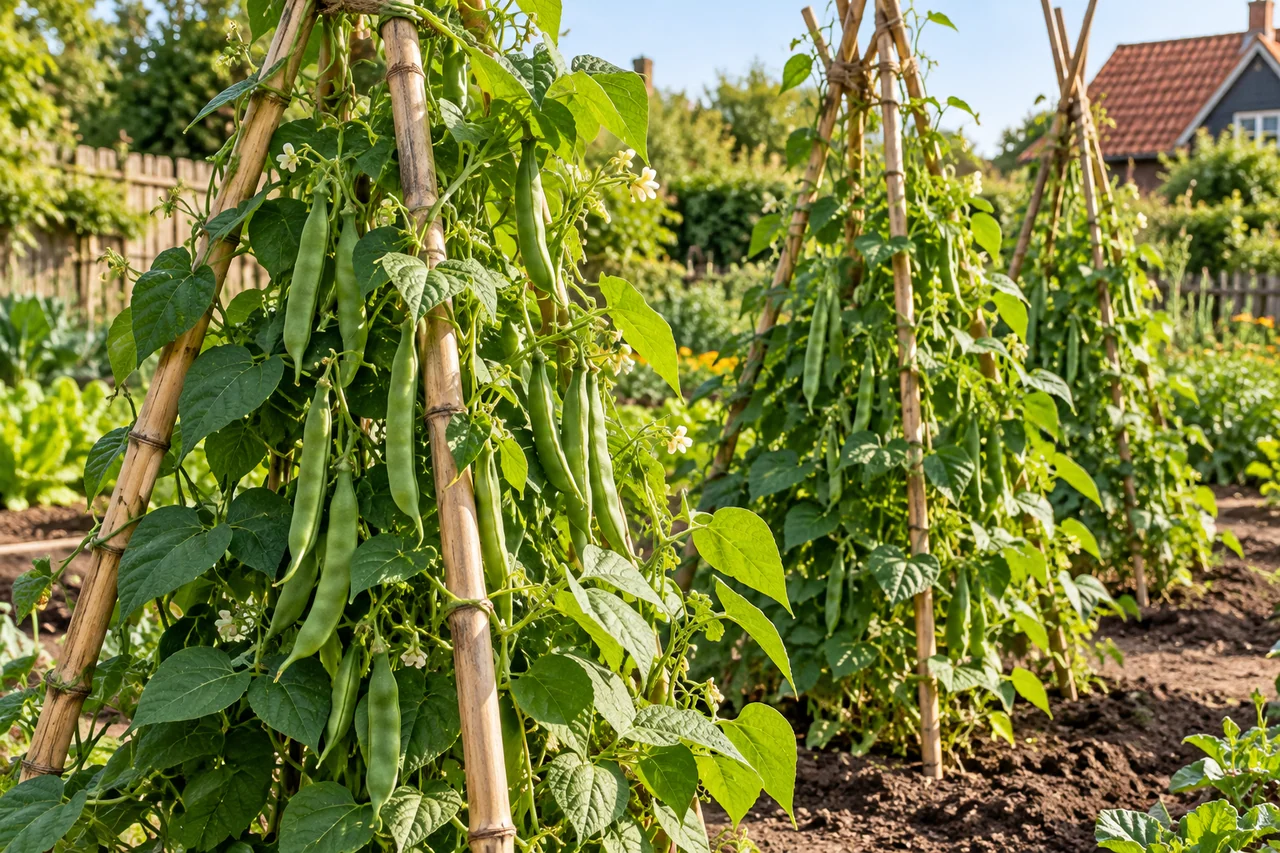
This image was created with AI from described plant characteristics and growing advice. It shows a possible situation and is not a photograph of a verified cultivar.
Put the support in place before climbing starts
A sturdy wigwam gives climbing beans a hold. Gently guide the first shoots towards the canes and keep the centre accessible for picking.
View your supplies →Choose by flavour, shape and use
Helda: Green climbing flat-podded bean for a wigwam or bean frame. Cut young pods into diagonal strips and cook thoroughly. Use fresh portions or blanch some following a suitable freezing method.
Helda has the mild bean character of cooked flat beans. The broad pod calls for a different approach to cutting than a slender French bean; picking young determines the tender bite.
Sunshine: Long, thin yellow pods on a climber. Cook young yellow pods whole and serve with fresh herbs. You can cut longer ones in half without slicing them into strips like broad flat beans.
Sunshine has a mild cooked-bean character. The slender yellow pod is the documented difference; butter bean does not imply a buttery fat content or fixed flavour score.
Neckargold: Long, yellow, fleshy pods on a climbing bean. Cook young pods whole or cut into equal pieces for a vegetable dish. Use little strongly flavoured sauce at the first tasting to experience the fleshy texture.
The fleshy yellow pod gives a mild bean character after thorough cooking. The source describes no proven sweetness difference from other yellow climbing beans.
Golden Gate: Broad, flat yellow slicing bean on a climber. Cut young pods into diagonal strips and cook thoroughly. A mix with green flat beans gives two colours; prepare pieces of equal width for an even bite.
Golden Gate has a mild cooked-bean character with a broad pod wall. The yellow colour and flat shape are more concrete than a separate cultivar-specific flavour note.
Make your growing choice first
Climbing beans need support; placing a dwarf bean against a tall pole does not change its growth habit. Choose how you want to harvest too. Young French or flat beans need a different picking routine from beans that must mature fully.
Wait for suitable outdoor weather
A bean from warm indoor air cannot immediately cope with a cold garden. Follow the frost forecast, harden the plant off and provide warm soil. A good start avoids trying to recover from several weeks of stalled growth.
Keep an eye on the soil
Water according to moisture around the roots, paying extra attention during flowering and pod formation. Keep young plants free of weeds. Growing in pots requires more frequent checks; a dry pot can still be dry inside after a brief shower.
Height starts with a choice
Climbing bean describes the climbing growth habit. It does not yet tell you whether you are growing round French beans, flat slicing beans or drying beans for their seeds. Read both parts of the cultivar profile. Add your intended harvest to the label too; this tells you which development to follow on the plant during the season.
Put the support in place before the plant needs it
A climbing support belongs in the bed from the start. Check that the canes or frame are sturdy and secure the joins. Think about reaching your hands between the future leaves too. A support covered in growth is only useful if you can find and pick pods from the path.
Wait for soil in which the bean can get started
Bean seed can rot in cold soil. Check both the soil and the weather before starting. A sunny afternoon above a bed that is still cold and wet offers a different starting point from warmed soil. Follow the packet instructions and record your sowing date so you can assess germination in context later.
The first shoots find their own hold
After germination, watch how the shoots reach the support. You can gently guide a shoot that has come loose. Walk along the other side of the bed too: what looks tidy from the path may be hanging loose at the back. This keeps the first climb clear to follow before the different plants form a dense green screen together.
Monitor moisture beneath the canopy
During dry spells, the root zone deserves attention, especially as pods form. Look below the surface rather than just at the colour of the topsoil. Shade from a support covered in growth changes what you see. Make this check a regular part of your garden round and record when you actually watered.
The pod tells you when to pick
For fresh French beans, harvest pods before the seeds bulge strongly. Look among the leaves too and compare what you find with the cultivar profile. Different beans naturally have different lengths and shapes. Do not let a general size guideline outweigh the intended young harvest stage.
A picking round needs two steady hands
The school garden handbook describes supporting the stalk when picking. This makes harvesting a deliberate action rather than pulling at the whole crop. Work from bottom to top and look back at places hidden behind leaves. A small basket and a regular route help you give it the same attention each time.
Record what growing upwards gave you
Chill fresh beans if you are not using them straight after picking. Also record your experience with the bed: where could you reach easily, which side did you often miss, and was the support practical? These notes give you a more concrete starting point next season than a photo of a climbing frame covered in growth alone.
What you need
Tick what you already have. The extras depend on how you grow.
0 of 4 ticked off
Your ticks are saved in this browser.
Discover and grow more
More background, sources and image information
SeedSteps editorial team · updated on 11 October 2026. The AI images illustrate species and practical growing situations; they do not prove an exact cultivar, observations from your own garden or yield.
Britse gewasadviezen worden gecombineerd met Nederlandse en Vlaamse informatie waar beschikbaar. Amerikaanse Extension-bronnen ondersteunen plantprincipes en herkenning; hun kalenderdata, lokale plaagdruk, bestrijdingsmiddelen en mestdoseringen worden niet rechtstreeks op Nederland of Vlaanderen toegepast. Vorst, bodemwarmte, standplaats en expliciete rasinformatie blijven de lokale controle. Commerciële bronnen onderbouwen uitsluitend benoemde ras- en plantkenmerken; zij zijn geen affiliate-aanbeveling.
- World Checklist of Vascular Plants — 4 juni 2026Royal Botanic Gardens, Kew · accessed 2026-10-07
- Common catalogue of varieties of vegetable species — 27 januari 2023Europese Commissie · accessed 2026-10-07
- Organic Stoksnijboon Helda zadenFeggies · accessed 2026-10-11
- Stokslaboon À Rames La Vigneronne BiologischFeggies · accessed 2026-10-11
- Stokslaboon (prinsessenboon) boter "Sunshine"Feggies · accessed 2026-10-11
- Stokslaboon (prinsessenboon) NeckargoldFeggies · accessed 2026-10-11
- Stokslaboon (snijboon) boter Golden GateFeggies · accessed 2026-10-11
- Stokslaboon (snijboon) SabreFeggies · accessed 2026-10-11
- Stokslaboon uit MechelenFeggies · accessed 2026-10-11
- Stokslaboon vroege NeckarköniginFeggies · accessed 2026-10-11
- Stokslaboon Wijnmaakster zaden biologischFeggies · accessed 2026-10-11
- Vigneronne (Weinländerin): StangenbohneSativa Rheinau · accessed 2026-10-11
- Bonen kiezen: groeivorm en oogstdoelDe Bolster · accessed 2026-10-08
- Sperziebonen: warmte, water en jong plukkenDe Bolster · accessed 2026-10-08
- RHS — boon kwekenRoyal Horticultural Society · accessed 2026-10-10
- UMD Extension — bonen kwekenUniversity of Maryland Extension · accessed 2026-10-10
- UMN Extension — boon in de moestuinUniversity of Minnesota Extension · accessed 2026-10-10
- Stam- en stokslabonen: groei en oogstRoyal Horticultural Society · accessed 2026-10-08
- Handboek Schooltuinen: raskeuze en plantuiHandboek Schooltuinen, via Velt · accessed 2026-10-08
- Bonen: groeivormen en verzorgingUniversity of Maryland Extension · accessed 2026-10-08
- Bonen: bodem, plukstadium en bewarenUniversity of Minnesota Extension · accessed 2026-10-08
Supporting evidence by chapter: Choose by flavour, shape and use: Feggies, Feggies, Feggies, Feggies. Make your growing choice first: Royal Horticultural Society, University of Minnesota Extension, University of Maryland Extension. Wait for suitable outdoor weather: Royal Horticultural Society, University of Minnesota Extension, University of Maryland Extension. Keep an eye on the soil: Royal Horticultural Society, University of Minnesota Extension, University of Maryland Extension. Height starts with a choice: De Bolster. Put the support in place before the plant needs it: University of Maryland Extension. Wait for soil in which the bean can get started: University of Minnesota Extension. The first shoots find their own hold: Royal Horticultural Society. Monitor moisture beneath the canopy: University of Maryland Extension. The pod tells you when to pick: De Bolster. A picking round needs two steady hands: Handboek Schooltuinen, via Velt. Record what growing upwards gave you: University of Minnesota Extension.